The AI industry is moving quickly from single model interfaces to ecosystems of intelligent agents that collaborate, reason, and take action on behalf of users. Fetch.ai has been preparing for this shift from the beginning and is now expanding its use of Google's AI technology to Google Cloud is scale Agentverse and bring multi-agent development to a broader community.
Together, we share a vision for an open and interoperable agentic future.
Agentverse now supports onboarding A2A agents from Google Cloud's ecosystem. These agents register in Agentverse, publish capabilities, and interoperate with uAgents through typed protocols. Orchestration can compose them alongside existing agents with clear roles and verified identities.
Our payments protocol has expanded to support AP2 flows. Agents can request funds, verify AP2 receipts, and complete work within a single protocol loop. This enables simple paywalls, metered APIs, auctions, and conditional delivery.
Builders would soon be able to select Google's most advanced models as agent capabilities. Gemini 3 for reasoning, Nano Banana Pro for accurate, context-rich visuals based on real-time information, and Veo 3.1 for video generation. These models sit behind typed interfaces so they can be composed safely with other agents.
Agentverse gives identity, discovery, typed protocols, and reliable message delivery. With A2A support and AP2 payments, teams can mix agents from both ecosystems, meter value exchange, and keep plans auditable. This lowers the time from prototype to production while keeping trust and cost control in focus.
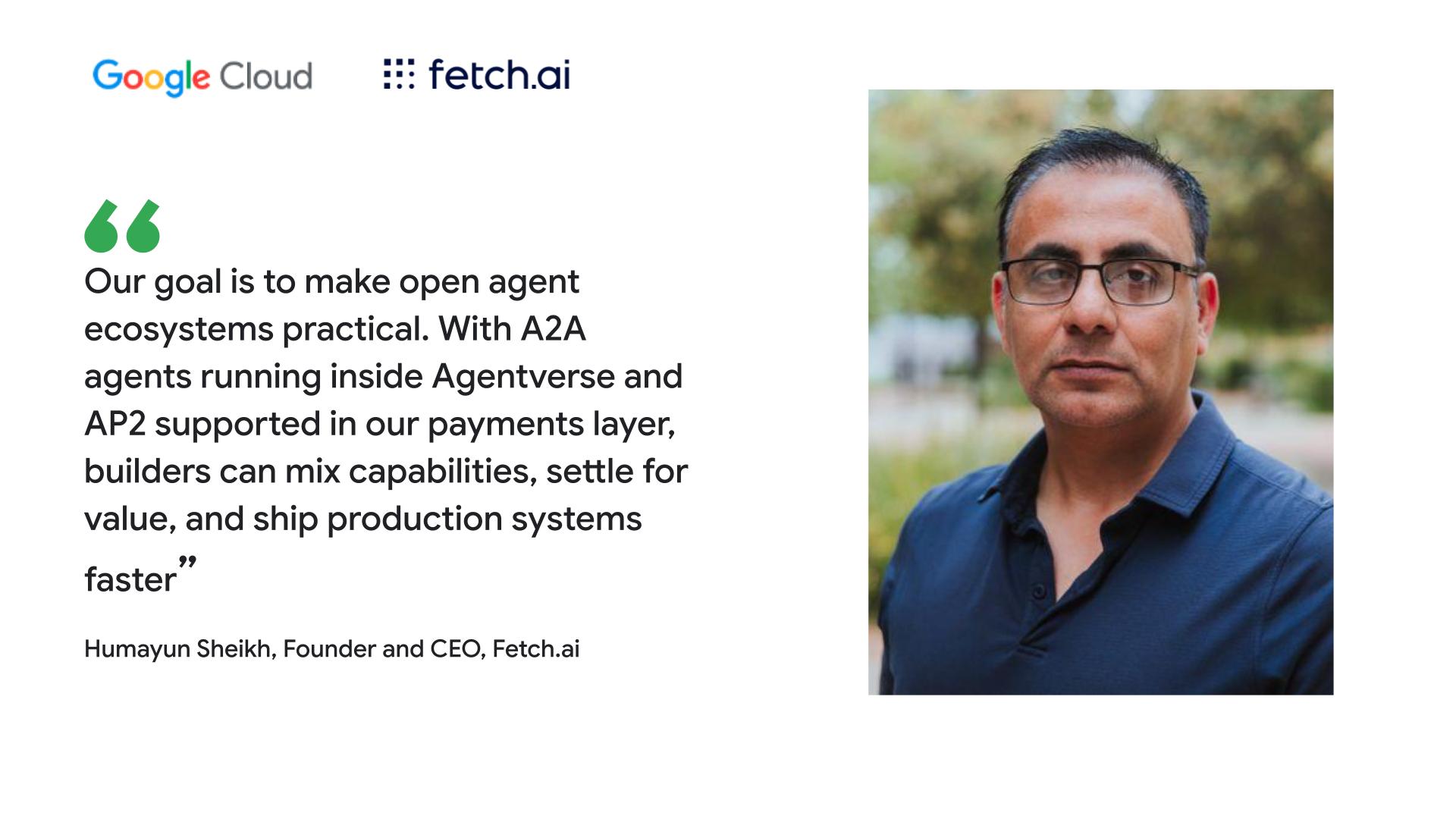
Fetch.ai's collaboration with Google Cloud marks a milestone for the broader AI ecosystem. As more organizations adopt multi-agent architectures, the industry will move from static chat interfaces to dynamic and interoperable networks of agents that collaborate across the open web.
By enhancing Agentverse and bringing leading AI technologies to Fetch.ai's platform, we are taking a major step toward that future. We are committed to accelerating this transition and cannot wait to see what developers create next.